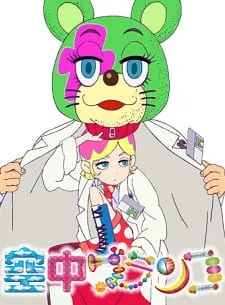
Loved Trapeze? Top 6 Picks for Experimental Art Fans
Anime Similar to Trapeze
Fans find the best anime like Trapeze based on community fan votes; Closest match: Mononoke.
Ever wonder if the doctor is actually crazier than the patient?
Fans connect to Trapeze because it visualizes the invisible chaos of the human mind with vibrant, unfiltered creativity. You’re likely looking for another show that breaks traditional animation rules while exploring deep psychological themes. This guide provides the best matches for your next watch. Only vote on matches if you've seen both shows.
A wandering Medicine Seller hunts spirits born from human malice in a visually stunning, paper-texture world.
Why it's similar: Both series share director Kenji Nakamura, utilizing an identical approach to experimental, high-contrast visuals to represent psychological states. They both follow an eccentric protagonist who diagnoses and 'cures' human afflictions using unconventional methods.
Power comparison: Rather than combat, both rely on identifying the specific nature of a mental or spiritual affliction to resolve the plot.
Why watch after Trapeze: If you loved the avant-garde art style of Trapeze, this is the most logical next step.
A college student relives his university years in parallel dimensions while searching for the perfect rose-colored life.
Why it's similar: Masaaki Yuasa’s direction mirrors Trapeze’s use of distorted perspectives and frantic pacing to illustrate the protagonist's internal neuroses. Both shows treat the human psyche as a playground for bizarre, non-linear animation techniques.
Power comparison: Both prioritize rapid-fire dialogue and internal monologues over physical action.
Why watch after Trapeze: Watch this if you enjoyed the fast-paced, witty commentary on human behavior and societal pressure.
Is the animation in Trapeze (Kuuchuu Buranko) all CGI?
No, Trapeze uses a unique mixed-media approach. It combines traditional 2D animation with rotoscoped live-action actors, CGI elements, and paper-cutout styles to create its signature disjointed, surreal aesthetic.
Does Trapeze have a manga or is it an original anime?
The anime is based on a series of short stories by Hideo Okuda. While it captures the essence of the source material, the avant-garde visual style is an original creation of the anime studio, Toei Animation.
In what order should I watch Trapeze?
Trapeze is a single-season series of 11 episodes. There are no sequels, prequels, or spin-offs, so you should watch it in the standard release order from episode 1 to 11.
Is there a romance subplot in Trapeze?
Trapeze does not have a central romance. While individual patients may have relationship-related stressors, the show focuses primarily on Dr. Irabu's eccentric psychiatric treatments and the internal growth of the patients.
An ultra-pessimistic teacher attempts to instruct a class of students who are all uniquely dysfunctional.
Why it's similar: Like Trapeze, this show uses a highly distinct art style to satirize specific mental health conditions and social anxieties. It treats heavy psychological topics with a mix of absurd comedy and sharp cultural criticism.
Power comparison: Characters use metaphorical exaggerations of their personality flaws rather than actual physical abilities.
Why watch after Trapeze: This is perfect for fans who liked the clinical, episodic breakdowns of different personality disorders in Trapeze.
A social phenomenon involving a bat-wielding assailant links a group of people suffering from extreme stress.
Why it's similar: Satoshi Kon’s masterpiece explores how psychological trauma and societal pressure manifest into surreal realities. It shares the episodic focus on different 'patients' whose internal lives eventually bleed into the external world.
Power comparison: Both shows focus on psychological delusions that physically manifest in the characters' environments.
Why watch after Trapeze: Watch this for a darker, more grounded take on the psychological breakdowns seen in Dr. Irabu’s office.
In a world where memories can be stored and traded, a man with no name travels to find his identity.
Why it's similar: The show uses a deceptive 'retro' art style to tell a deeply complex, surreal story about the human soul and memory. It matches Trapeze's willingness to use abstract imagery to explain complicated emotional concepts.
Power comparison: Combat involves the literal manipulation of memory chips and body-swapping rather than traditional magic.
Why watch after Trapeze: Choose this if the abstract and often jarring transformations in Trapeze were your favorite part.
Two brothers must find a mysterious 'Penguindrum' to save their dying sister, guided by a hat-wearing entity.
Why it's similar: Kunihiko Ikuhara utilizes heavy symbolism, bright colors, and 'stage-like' direction that mirrors the theatrical chaos of Dr. Irabu’s clinic. Both use repeating motifs and surreal logic to uncover hidden family and social trauma.
Power comparison: Magical realism drives the plot forward through symbolic transformations rather than tactical battles.
Why watch after Trapeze: This is for the fan who wants a more narrative-heavy experience that still retains a peak 'weirdness' factor.