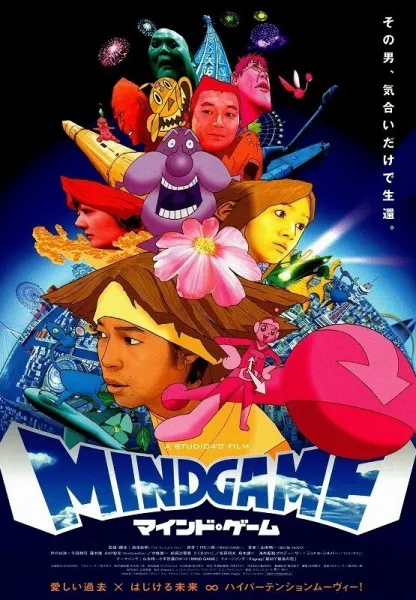
Loved Mind Game? Top 6 Picks for Surreal Odyssey Fans
Anime Similar to Mind Game
Looking for anime like Mind Game? Based on community fan votes, your Best starting pick is The Tatami Galaxy.
Ever wish you could hit the reset button on your entire life after a single embarrassing moment?
Fans connect with Mind Game because it captures the chaotic, messy energy of being human through a psychedelic lens. If you want more visual experimentation that explores second chances and existential joy, these picks are for you. Please upvote your matches only if you have watched both titles to keep the rankings accurate.
A nameless college student endlessly loops through his university years trying to achieve a 'rose-colored' life. It’s a rapid-fire masterpiece about the choices we make.
Why it's similar: Both works are directed by Masaaki Yuasa and share a signature fluid, abstract art style that mirrors the protagonist's internal state. They both tackle the theme of breaking free from self-imposed mental prisons to embrace life's messy reality.
Power comparison: Neither features combat powers, focusing instead on psychological hurdles and the subjective perception of time.
Why watch after Mind Game: Watch this if you want a more structured, episodic take on Mind Game's 'seize the day' philosophy.
A therapist uses a device to enter people's dreams, but reality begins to dissolve when the technology is stolen. It’s a visual feast of parade-like madness.
Why it's similar: Like Mind Game, this film uses the medium of animation to do things live-action never could, specifically blurring the lines between imagination and the physical world. The transition between scenes is fluid, dreamlike, and often overwhelming in the best way.
Power comparison: While Mind Game is grounded in a weird reality, Paprika features dream-based logic where characters can transform their shapes at will.
Why watch after Mind Game: This is the perfect follow-up if the psychedelic, 'anything can happen' visuals were your favorite part of Mind Game.
In what order should I watch Masaaki Yuasa's films?
There is no strict narrative order since his works are standalone. However, starting with Mind Game (2004) gives you a foundation for his style, followed by The Tatami Galaxy for his peak TV work, then Night is Short, Walk on Girl as a spiritual capstone.
Is Mind Game based on a manga?
Yes, Mind Game is adapted from Robin Nishi's manga of the same name. While the movie follows the core plot of Nishi being killed by a yakuza and escaping Limbo, Masaaki Yuasa significantly expanded the visual experimentation and surreal elements for the film.
Is there a sequel to Mind Game?
No, Mind Game is a self-contained feature film. The story concludes definitively with the characters' escape and their renewed outlook on life. Fans looking for similar vibes should explore the director’s other works like The Tatami Galaxy or Kemonozume.
Does Mind Game have any romance?
Yes, the driving force of the plot is Nishi's lifelong crush on Myon. However, it isn't a traditional romance; it's a frantic, surreal exploration of his regrets regarding her and his ultimate decision to finally take action to protect their future.
Two orphans protect their sprawling, decaying city from corporate developers and supernatural threats. The art style is gritty, distorted, and deeply immersive.
Why it's similar: It shares a rejection of 'standard' anime aesthetics in favor of a hand-drawn, wobbly, and highly detailed world. Both films focus on a deep, almost spiritual connection to a specific location and the struggle to maintain one's identity within it.
Power comparison: The protagonists exhibit superhuman agility and strength, but it's treated more like a heightened physical reality than a magic system.
Why watch after Mind Game: Watch this for a more grounded, emotional story that still maintains a high level of visual distortion and unique character designs.
One girl's epic, booze-filled night out in Kyoto turns into a surreal journey through seasons and eccentric social circles. It's a whimsical spiritual successor to Yuasa's earlier works.
Why it's similar: It carries the same frantic, celebratory energy found in the finale of Mind Game. The logic is loosely tied to reality, allowing characters to experience years' worth of events in a single evening through visual metaphors.
Power comparison: Combat is replaced by drinking contests and musical theater, emphasizing character personality over traditional systems.
Why watch after Mind Game: This is your best choice if you loved the upbeat, life-affirming conclusion of Mind Game and want more of that vibe.
Two amnesiacs wake up naked on Earth and go on a hyper-violent crime spree that lands them in a high-security prison on the Moon. It is pure, unfiltered adrenaline.
Why it's similar: If you enjoyed the high-speed chase and the crude, energetic humor of Nishi's escape, Dead Leaves dials that up to eleven. It uses a comic-book aesthetic with aggressive line work that matches the frantic pacing of Mind Game's opening.
Power comparison: The powers here are mechanical and cartoonish, focusing on slapstick violence rather than strategic combat.
Why watch after Mind Game: Pick this if you want a short, 50-minute burst of absolute chaos that ignores all traditional storytelling rules.
In a world where memories can be stored in chips and bodies are replaceable, a man with a hole in his chest travels across planets to find his identity. It looks like an old-school cartoon but hides deep philosophical pain.
Why it's similar: Another Yuasa creation, Kaiba uses a simple, Astro Boy-esque art style to explore complex adult themes like the soul and memory. It mirrors Mind Game's ability to use abstract visuals to convey profound emotional truths.
Power comparison: The power system involves body-swapping and memory manipulation, serving as a tool for social commentary rather than fighting.
Why watch after Mind Game: Watch this if you want a more melancholic and thoughtful exploration of the existential questions raised in Mind Game.