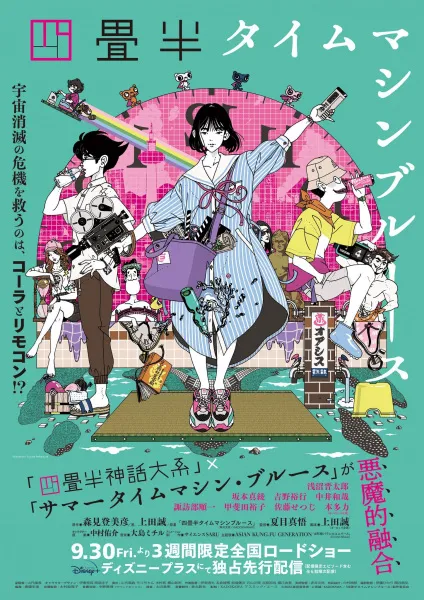
5 Anime Like Tatami Time Machine Blues: Surreal Sci-Fi
Anime Similar to Tatami Time Machine Blues
Looking for anime like Tatami Time Machine Blues? Based on fan votes, the Top match is The Tatami Galaxy.
Ever ruined your life over a broken remote and a 25-year-old time machine?
Fans love the frantic, linguistic charm and Groundhog Day vibes of Kyoto student life. This guide helps you find that same surreal energy and witty dialogue. You can upvote or downvote these matches; please only vote if you’ve watched both shows.
A college student repeatedly relives his first year of university to find the 'rose-colored' life. It’s the direct predecessor to Time Machine Blues.
Why it's similar: It features the exact same cast, art style, and lightning-fast narration. This is the definitive companion piece that establishes the protagonist's relationship with Ozu and Akashi.
Power comparison: It focuses on the psychological 'power' of choice and regret rather than physical abilities.
Why watch after Tatami Time Machine Blues: You should watch this first if you haven't, as it provides the essential context for the characters' dynamics.
One epic, surreal night in Kyoto where two students' paths cross through various bizarre social circles. It shares the same author and director.
Why it's similar: The movie exists in the same universe and features cameos from the Tatami cast. It mirrors the 'fever dream' pacing and vibrant, flat-color aesthetic found in the time machine incident.
Power comparison: The logic is dream-like and metaphorical, focusing on endurance and alcohol rather than supernatural systems.
Why watch after Tatami Time Machine Blues: Watch this if you want a more romantic, celebratory take on the eccentric student life shown in the series.
Do I need to watch The Tatami Galaxy before Time Machine Blues?
While it's a standalone story, watching The Tatami Galaxy first is highly recommended. It establishes the complex relationships between the Protagonist, Ozu, and Akashi, making the callbacks in Time Machine Blues much more satisfying.
Is Tatami Time Machine Blues a direct sequel or a spin-off?
It is a sequel/spin-off hybrid. It uses the characters from The Tatami Galaxy but places them in the plot of Makoto Ueda's play 'Summer Time Machine Blues,' creating a unique crossover story.
How many episodes are in Tatami Time Machine Blues?
The series consists of 6 episodes. The first 5 cover the main time-travel plot, while the 6th episode is an original story exclusive to the streaming release that isn't found in the novella.
Is there a romance subplot in Tatami Time Machine Blues?
Yes, the relationship between the unnamed protagonist and Akashi is a central focus. The time travel antics often serve as a catalyst for the protagonist to finally make a move and ask her out.
A class of students is drifted into a void where they must navigate strange worlds with abstract rules. It’s an experimental visual masterpiece.
Why it's similar: Like the time machine mess, it uses a unique art style to explore high-concept sci-fi themes. It prioritizes atmosphere and existential questioning over traditional linear storytelling.
Power comparison: Characters possess 'superpowers' that function more like manifestations of their internal mental states.
Why watch after Tatami Time Machine Blues: Perfect for fans who enjoyed the unconventional directing and the 'logic' of a world gone wrong.
A self-proclaimed mad scientist accidentally discovers a way to send messages to the past using a microwave. Things escalate from hobbyist fun to a conspiracy.
Why it's similar: Both shows center on a group of eccentric friends in a cramped room tinkering with a low-budget time machine. They share the 'summer heat' aesthetic and the panic that comes with butterfly effect consequences.
Power comparison: The time travel rules are much more rigid and grounded in theoretical physics compared to the whimsical nature of the remote control quest.
Why watch after Tatami Time Machine Blues: Watch this if you want a more high-stakes, dramatic exploration of the consequences of changing the past.
A precocious young boy investigates the sudden appearance of penguins in his small town during a hot summer. It’s a whimsical sci-fi mystery.
Why it's similar: It captures the specific 'scientific curiosity' and bright summer atmosphere of Tatami. Both use a youthful lens to look at impossible phenomena occurring in a mundane setting.
Power comparison: The mystery is driven by environmental anomalies rather than character-driven combat or powers.
Why watch after Tatami Time Machine Blues: Pick this if you loved the intellectual tone and the bright, breezy visual style of the Kyoto summer.